
Alhambra and Generalife
By far the most famous of Granada’s monuments is the spectacular Alhambra, or “red palace”, which is one of the finest and best-preserved examples of historic Islamic architecture in the world. Set on a hill that dominates the modern city, its intricately ornate decoration, peaceful patios and delightful gardens are a must-see for any visitor to Granada.
In its heyday, the Alhambra served various functions: it was a garrisoned fortress, a fortified citadel and a magnificent royal palace.
History
By the mid-1200s, the Christians controlled almost all of the Iberian peninsula, but the Muslim Kingdom of Granada held out, ruled by the Nasrid dynasty. The kingdom was politically and militarily weak, and its rulers had to pay tributes to Castile, but at the same time it was very wealthy, thanks to its silk industry and agriculture.
In 1238, Muhammad I, the founder of the Nasrid Dynasty, decided to move the royal residence from the Albaicín to the hill opposite, where there was a small fortress. He strengthened the fortifications of the Alcazaba (fortress) by expanding the walls and adding new towers, including the mighty Torre de la Vela.
Around the turn of the 14th century, the Generalife was built on a hill opposite the Alhambra. It was an almunia – a farm, but also a retreat where Granada’s rulers could get away from everything and relax.
Later in the 14th century, the stunning Nasrid Palaces were added. As well as providing an elegant home for the rulers of Granada, the palaces were where the sultans received foreign ambassadors and handed down justice.
After their conquest of Granada, the Christians kept most of the Alhambra intact. However, they made various alterations, including adding the huge, square Palace of Charles V and the Church of Santa María de la Alhambra during the 16th century.
During the Napoleonic Wars in the early 1800s, the occupying French forces caused a lot of damage to the Alhambra. When they were forced to retreat, they even tried to blow it up – fortunately unsuccessfully. By the time Washington Irving visited in the 1820s, It was still in a lamentable state of disrepair. It was only in the 1900s that restoration work started in earnest.
Architecture
Alcazaba
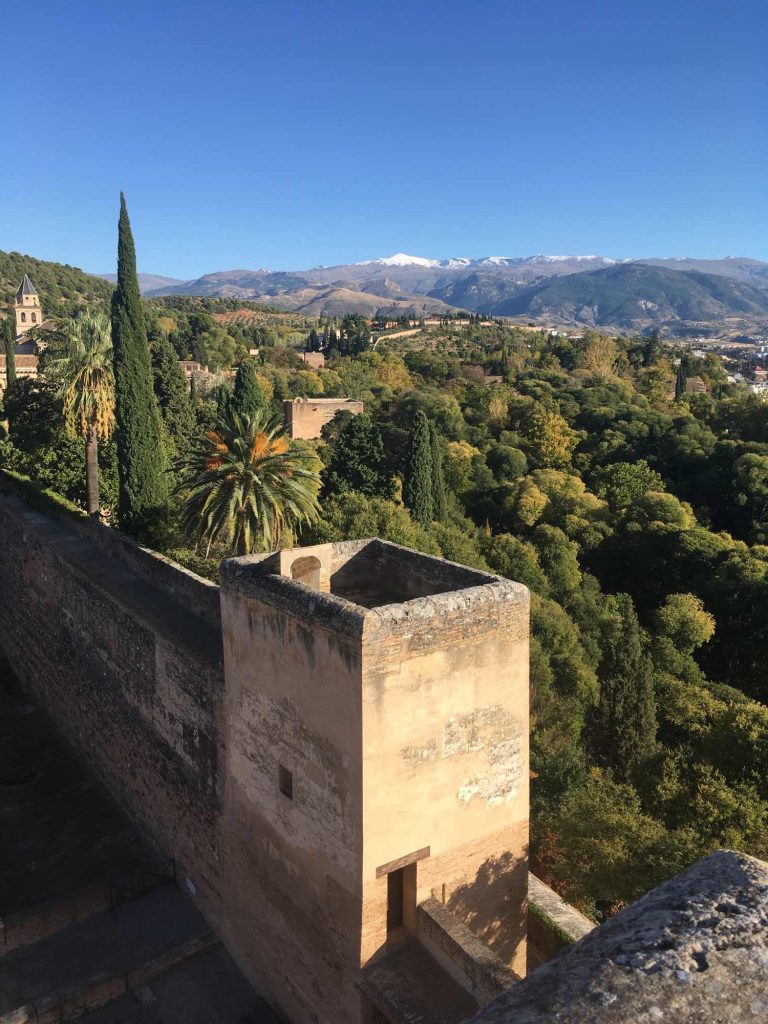
The austere Alcazaba is the oldest part of the Alhambra, and it’s a mainly defensive construction with few decorative elements. There are great views from its bastions and towers, both across the city and up to the Sierra Nevada mountains.
Nasrid Palaces
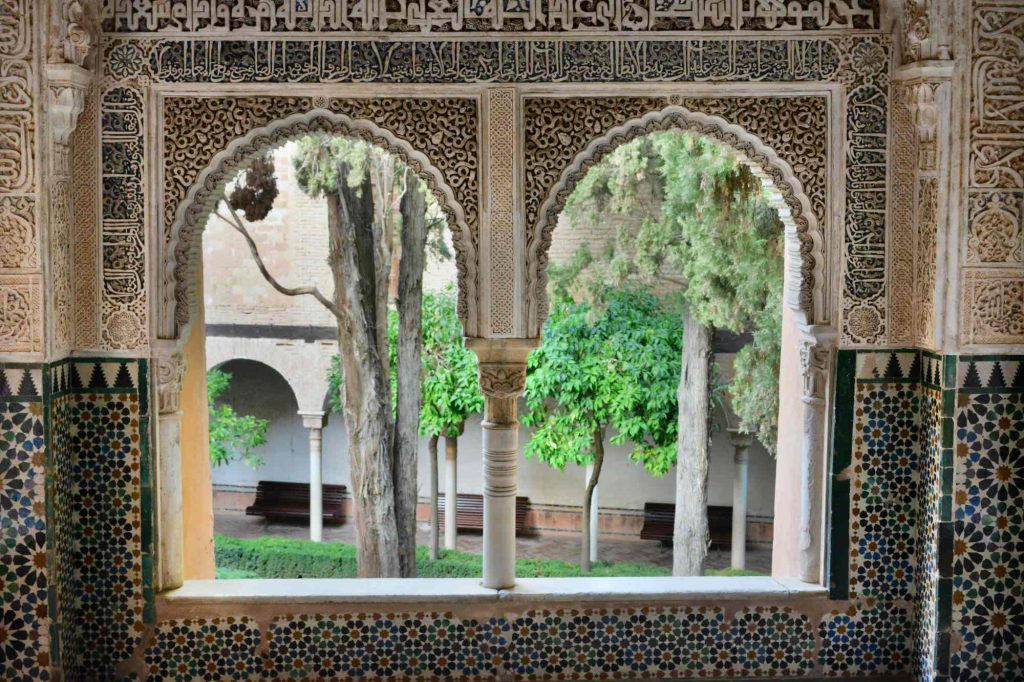
The highlight of any visit to the Alhambra is the stunning Nasrid Palaces, considered to be the pinnacle of Moorish architecture in Andalucía. The style incorporates Islamic and Christian influences, including horseshoe and multifoil arches. The exquisite craftsmanship of the ceramics, stucco and inlaid wooden ceilings is extraordinary.
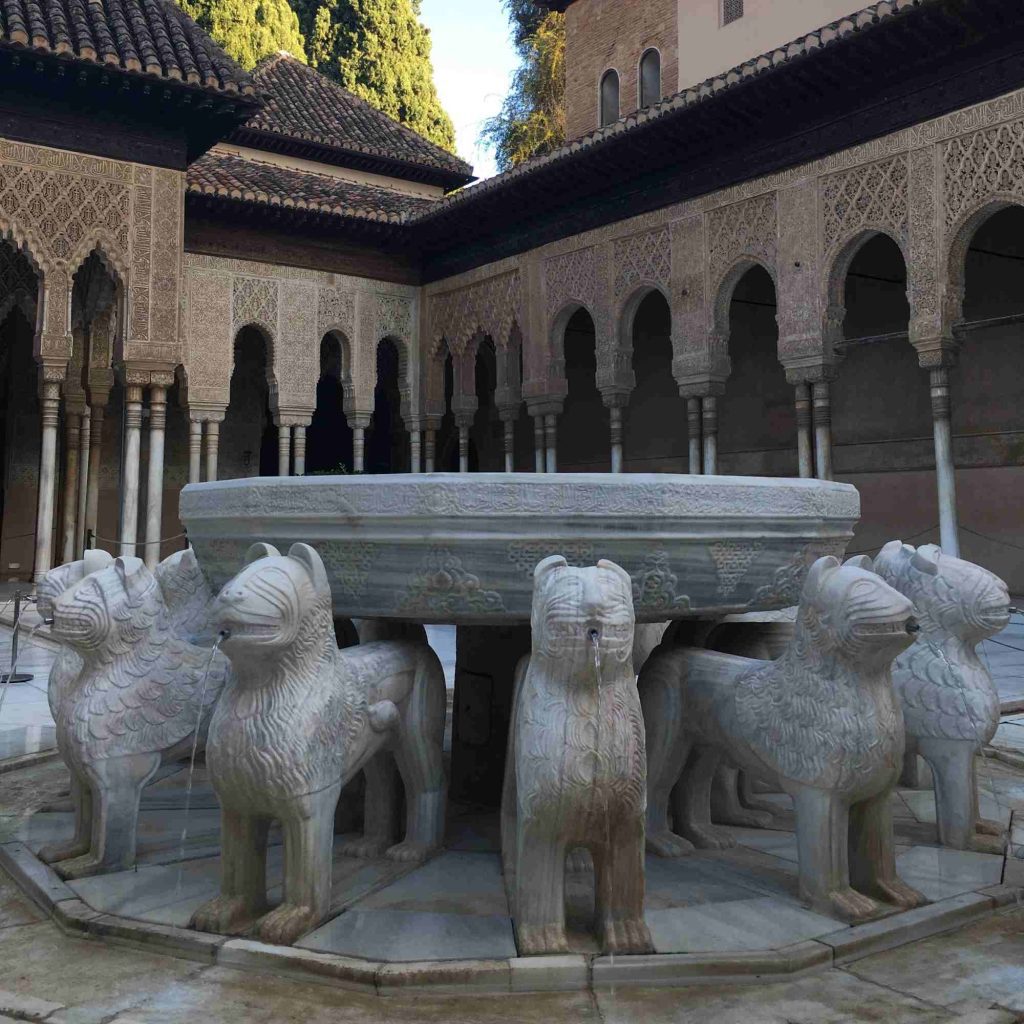
The Nasrid Palaces include three separate palaces: the Mexuar, Palacio de los Comares (Palace of Comares) and Palacio de los Leones (Palace of the Lions). The latter is where you will find the famous Patio de los Leones (Court of the Lions), where 12 lovingly restored lion statues hold up the central fountain.
Generalife
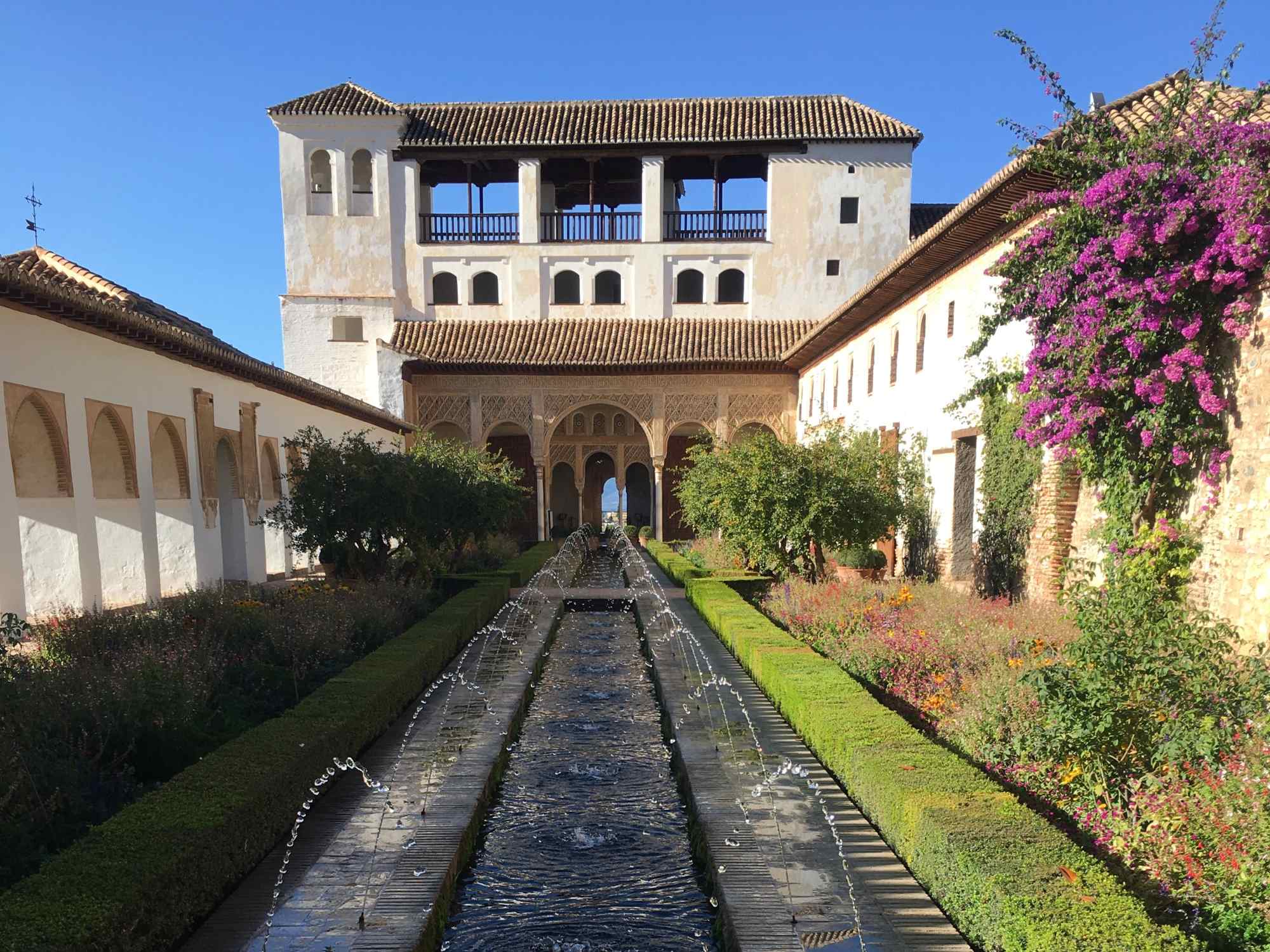
With several beautiful patios, charming gardens and lovely views, the Generalife is another highlight of the visit. The cover photo of this page shows the Patio de la Acequia (Court of the Main Canal) at the Generalife.
Water features
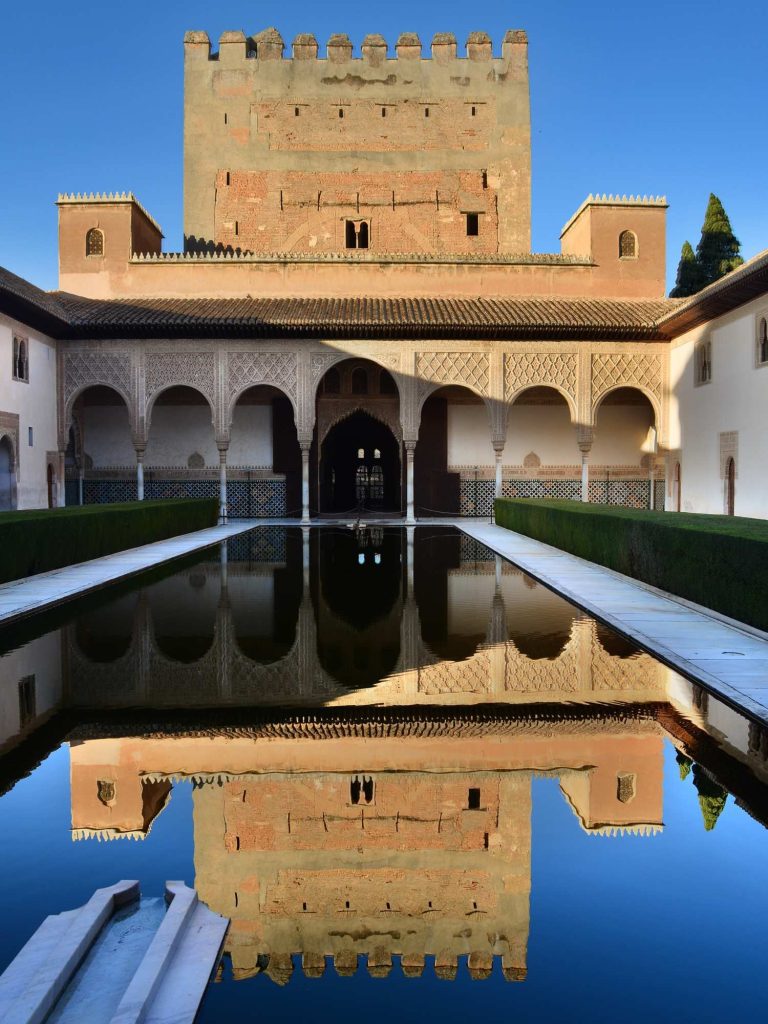
All through the Nasrid Palaces and the Generalife, you can see the pivotal role of water, which was used to make the palaces feel cooler, as well as symbolising purity and life. Also, the beautiful reflections show the surrounding buildings moving, which alludes to the belief that only Allah is unchanging.
Planning your visit
Most people spend 3-4 hours visiting the Alhambra, but you can easily spend the whole day exploring the complex and surrounding area. You need a ticket to enter three separate areas:
Nasrid Palaces and Partal Gardens
This is the highlight of the visit, so make sure you save enough time and energy to enjoy it properly. When you exit the palaces, you go through into the lovely Partal Gardens.
Your ticket includes a specific time for entering the Nasrid Palaces; you have half an hour from that time, so if your ticket says 14:00, for example, you can enter the palaces from 14:00-14:29. If you are late, the staff cannot let you in, so it is really important to keep an eye on the time!
Typical length of visit: around 1 hour.
Alcazaba
The entrance to the Alcazaba is opposite the entrance to the Nasrid palaces. The fortress can be brutally hot in summer, so if you’re here in July or August, the best time to visit is in the morning.
Typical length of visit: 30-45 minutes.
Generalife Palace and Gardens
The main entrance to the Generalife is next to the main ticket office, at the top of the Alhambra. If you haven’t yet visited the Nasrid Palaces and Alcazaba, you can exit the gardens by crossing a small bridge towards the Parador hotel. This saves a lot of walking compared with leaving by the main entrance.
If you have visited the Nasrid Palaces and Alcazaba first, you can enter the gardens of the Generalife either through this entrance by the Parador or directly from the Partal Gardens.
Typical length of visit: 45-60 minutes.
In addition to the ticketed areas, some parts of the Alhambra can be visited free of charge, including the Palace of Charles V. It houses the Alhambra Museum, Museum of Fine Arts and various temporary exhibitions. You can access the free areas through the Puerta de la Justicia (“Justice Gate”) or Puerta de los Carros (“Cart Gate”), which is also how you reach the entrances to the Nasrid Palaces and Alcazaba.
Official Alhambra website: https://www.alhambra-patronato.es/
Buying your ticket
We recommend buying your Alhambra ticket as soon as you can after they go on sale (usually around a year in advance).
The process of getting a ticket for the Alhambra can be a bit confusing. The official ticket website offers various ticket options, including:
- Alhambra General: provides access to the Nasrid Palaces and Partal Gardens, Generalife Palace and Gardens and Alcazaba.
- Gardens, Generalife and Alcazaba: provides access to the Generalife Palace and Gardens, Alcazaba and Partal Gardens (which you enter through a back door), but not the Nasrid Palaces.
- Dobla de Oro General: same as the Alhambra General ticket, but also includes access to several sights in the city, including the Arab baths.
- Nighttime entry to the Nasrid Palaces or Gardens and Generalife.
If you buy the Alhambra General or Dobla de Oro General ticket, you will need to choose an entrance time for the Nasrid Palaces (see above).
Tickets are non-refundable and non-transferable. You will be asked to show ID to prove that you are the person named on the ticket, so bring your passport or national ID card. Children aged 3-11 can visit the Alhambra free of charge, but you must book them a ticket at the same time as buying the adult tickets. For children aged 0-2, you will need to pick up a free ticket at the main ticket office.
Official ticket website: https://tickets.alhambra-patronato.es/en/
What to do if the Alhambra tickets have sold out
If the Alhambra General tickets have sold out, don’t panic – you do have a few options.
- See if you can get one of the other ticket types available on the Alhambra website as they may have a separate allocation of slots for the Nasrid Palaces.
- Check the website again regularly. The tickets are released in batches, so extra tickets do become available periodically. There are no guarantees, but you can be lucky, even if you leave it to the final days or weeks before your planned visit.
- See if you can get the Granada Card, which is a combined ticket that includes the Alhambra as well as other museums and sights in Granada. There are 24, 48 and 72 hour versions available but only the 48 and 72 hour versions include the full Alhambra visit. It’s significantly more expensive than the standalone ticket, but it also includes a lot of other sights such as the Cathedral and Royal Chapel.
- Join a guided tour that includes an entrance ticket (see below). But BEWARE: some guided tours only include the Gardens, Generalife and Alcazaba ticket and NOT the Nasrid Palaces. Some companies also sell overpriced tours and receive extremely poor reviews, in some cases even failing to provide the ticket or the guided tour that has been purchased. If you decide to join a guided tour, do some quick research before buying to avoid disappointment.
Audioguides
As of autumn 2025 the official audioguide for the Alhambra has been withdrawn from sale, although a new version is planned and may be available by the time you visit. There is a VoiceMap audioguide covering the Nasrid Palaces and Charles V Palace (not produced by us!). This allows you to enyoy the Alhambra at your own pace, rather than being part of a group.
Guided tours
Some people prefer a guided tour with a real person, which may be more comprehensive and offers the chance to ask questions. Another reason for getting a guide is that sometimes tickets run out completely. In those cases, hiring a guide may be the only way to see the Alhambra. As indicated above, always check the credentials of the guide and what kind of ticket is included.


Questions and answers
Most of the Alhambra as you see it today was built in the 13th and 14th centuries. Work on the Alcazaba began in 1238, the Generalife was built around the turn of the 14th century, while the Nasrid Palaces were mainly built in the 14th century. The Palace of Charles V and the Church of Santa María de la Alhambra are Christian buildings added in the 16th century.
The Alhambra was a citadel or fortified town, governed separately from the city of Granada. It included a garrisoned fortress, palaces where the rulers of the Kingdom of Granada lived and received foreign dignitaries, the homes of members of the court, and extensive gardens.
Yes! Tickets for the Alhambra can sell out many months in advance, so buy your ticket as soon as possible.
The first tickets go on sale for the Alhambra about a year in advance. Further batches are released periodically, so even if you find them sold out, it can be worth checking again regularly. Note: the Alhambra ticketing system has changed in the last few years, so you might see other websites saying that they can only be purchased much nearer the planned visit.
Only buy tickets from the Alhambra’s official website: https://tickets.alhambra-patronato.es/. Other vendors may add a significant commission to the ticket price – we have seen reports of some very unscrupulous practices.
If it is your first time visiting the Alhambra, you should buy the Alhambra General ticket. This includes entry to the Nasrid Palaces, Alcazaba, Generalife and Partal. If you have already visited the Alhambra, you might want to consider some of the other ticket options, including a nighttime visit to the Alhambra.
Yes, visiting the Alhambra at night is a beautiful experience, but you shouldn’t do it instead of a daytime visit to the Alhambra, as you can only visit the Nasrid Palaces.
Don’t panic, there are various other options available:
– Check whether the Dobla de Oro General or 48/72-hour Granada Card still have time slots available for the Nasrid Palaces.
– Join a guided tour that includes a full entrance ticket to the Alhambra, including the Nasrid Palaces. Some tours only visit the Gardens, Generalife and Alcazaba, and some have very poor reviews, so do some basic research before buying.
– Tickets are released in batches. Check the official website regularly to see whether any more tickets have been released.
– Buy a ticket to the Gardens, Generalife and Alzacaba. This means missing out on the Nasrid Palaces, which are generally considered to be the highlight of a visit to the Alhambra, but it’s still much better than nothing.
It’s tricky to find any free parking within easy reach of the Alhambra. Most on-street parking in the centre of Granada is pay-and-display, so you would need to park a long distance away on the edge of the city. If you don’t want to take a bus up, it’s a steep uphill climb. The car park at the Alhambra itself isn’t cheap, but it’s by far the most convenient place to park.