
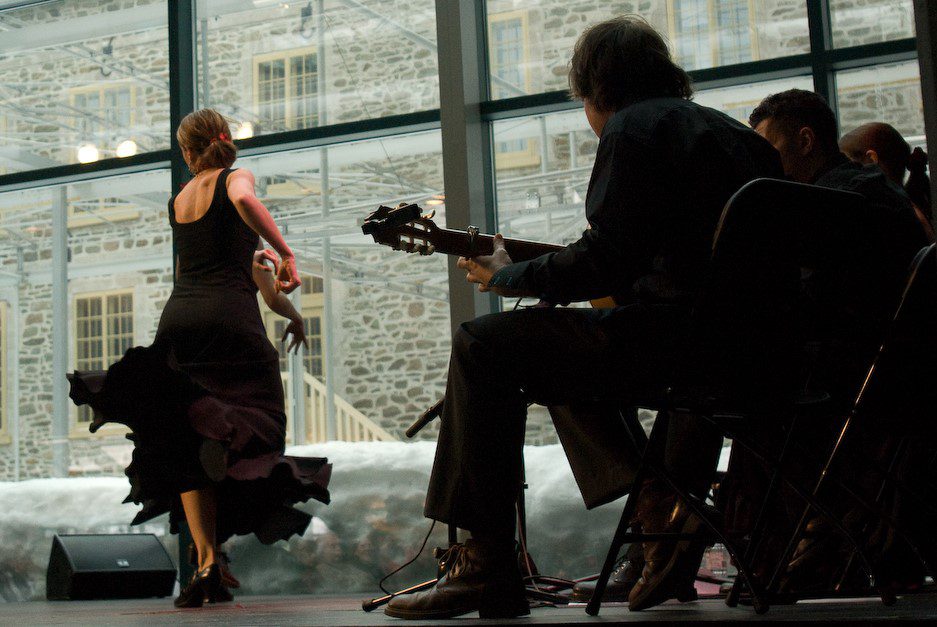
The Art of Flamenco
For many visitors to Andalucía, seeing a passionate flamenco show is a highlight of their trip, and one they remember for the rest of their lives. Others come away disappointed, because they haven’t seen a partner dance, or because they find the singing and foot-stamping too strident. We’re certainly not going to argue about personal tastes, but sometimes part of the problem is people’s expectations – they think a flamenco show will be something that it isn’t. So here’s a beginner’s guide to flamenco, including its history and traditions, and what you can expect from a flamenco performance in Andalucía these days.
Common misconceptions
The first common mistake is thinking flamenco is a kind of dance, but really it’s a form of music and artistic expression, where song, dance and guitar playing are all equally important. In fact, a lot of music you hear on the radio in Spain is flamenco or a fusion of flamenco with rock and pop – in other words, it’s very much something to listen to, as well as to watch.
Another, related mistake is thinking that flamenco is danced by women in red dresses. This is probably because people have been to the Feria de Abril in Seville and seen women dancing Sevillanas. But Sevillanas are arguably not flamenco at all, and can in any case be danced by men too.
The roots of flamenco
Anyway, so much for what flamenco isn’t – what is it? To understand that, we need to go back to its origins. Here there’s a bit of controversy about whether it’s a purely Gitano – Roma – art form, or a Spanish and Andalucian one. People who emphasise flamenco’s Andalucian roots point out it’s not present in Roma culture elsewhere. While this is true, it plays down that everywhere flamenco arose in the 18th century – Jerez, Seville, Granada – it was amongst Roma communities or ones with a very strong Roma presence.
So, flamenco was probably originally an artistic expression of Roma culture, but one that was deeply influenced by the people that surrounded them in 16th-18th century Andalucía. This included mainstream Spanish culture, of course, but there are also traces of the music of the Moriscos (converts from Islam) and Judeoconversos (converts from Judaism) in flamenco. And the melting pot of cultures from which flamenco emerged also included African slaves and immigrants from Spain’s colonies in the new world – according to the experts, you can hear echoes of their rhythms and music in flamenco.
The reason flamenco’s origins are somewhat shrouded in mystery is that it wasn’t originally performed in theatres or concert halls: people improvised it for their own entertainment, to celebrate special occasions and to sing while they worked. Flamenco is sometimes associated with drama and tragedy, and some styles of flamenco do indeed focus on death and loss. But there are also joyful styles for weddings and other celebrations, as well as ones for seduction and romance, or to mark religious occasions. In short, the whole range of human emotion.
The first flamenco shows
It was only in the second half of the 19th century that flamenco began to draw the attention of outsiders. That’s when Romantic travellers started visiting Andalucía, fascinated by its exotic allure and drawn by books like Washington Irving’s Tales of the Alhambra. They saw Andalucía as being uncorrupted by the industrialisation and affectations of the modern world, and the Roma and art of flamenco fitted perfectly into that vision. Spotting the opportunity to make some money from the visitors, local people started dressing up in traditional costume and putting on flamenco performances. This developed into cafés with performances – like the café-chantant of Paris, famous from Impressionist paintings. Perhaps unsurprisingly, many of these commercialised performances had little relationship with the cultural origins of flamenco.
Modern flamenco
As a backlash against that, the poet and dramatist Federico García Lorca, together with the composer Manuel de Falla and other members of Andalucía’s cultural elite, put on a cante jondo competition in Granada in 1922. Cante jondo is a highly emotional form of song which is often considered the purest and earliest manifestation of flamenco, so the competition was all about returning to flamenco’s roots. Looking back, 1922 is seen as a turning point in the development of modern flamenco. This is when it began to be seen as an art form, and not just vulgar entertainment. Flamenco performers became highly respected – and in some cases well paid – artists, and pompous flamencólogos (experts on flamenco) started opining about what is and isn’t true and good flamenco.
But flamenco’s strength has always been its ability to assimilate other influences, and improvisation means it’s constantly changing. New styles emerge, and artists blend flamenco with other forms of music. It may be an art form, but it’s very much a living one. It’s also one that requires a great deal of skill – singers, dancers and guitarists all train for many years to begin to master the art of flamenco.
What to expect
So, after all this, what should you expect from a flamenco performance? Typically, one male and one female dancer, who will mainly dance separately. And a singer, of course – usually one, but sometimes two, in which case it will be a man and a woman. Then there’s the guitarist, who accompanies the song and dance, but almost always also plays a solo piece, often heavily improvised. That’s true of all of the performers – shows are carefully rehearsed, but there’s always room for more or less improvisation within the overall framework. No two shows will be exactly the same.
People often ask whether performances for tourists are authentic, or whether it’s better to see a spontaneous bit of flamenco in a bar. Authentic is a very subjective word, but good flamenco artists want to be paid for their performances – it’s how they make a living, after all – so you’ll almost always have to pay to see a really good show, whether it’s in a bar, a theatre or a small back room. Of course, some venues are better than others, so do look at the reviews – not just the scores, but what people say. The good news is that the performers will generally be highly trained and experienced, and very many of them still come from the Roma community.
Finally, a couple of dos and don’ts. Don’t join in the clapping, unless specifically asked to. Clapping (called “palmas”) is a percussion instrument, which takes years to master. Even if you have a brilliant sense of rhythm, you’ll almost certainly be clapping out of time and putting off the performers. On the other hand, do let yourself be transported by the music and dance. If you’re not used to them, the harmonies and rhythms of flamenco can sound strange, and even jarring, but if you go with the flow, you’ll probably have a wonderful experience.


Featured image photo credit: Jean-David & Anne-Laure (CC BY-SA 2.0)
Questions and answers
The precise origins of flamenco are disputed, but everywhere flamenco emerged in Andalucía, it was amongst communities with a very strong Roma presence. The Roma people continue to play a huge role in flamenco culture.
Yes, flamenco arose in Andalucía in the 18th century, drawing on the region’s musical traditions, and particularly those of the Roma community.
Seville is most famous for its flamenco scene, but you can see good flamenco shows in most cities in Andalucía.
Normally, there are two dancers – one man and one woman. In a typical performance, they will mainly dance individually, but they will often also do a dance or two together.